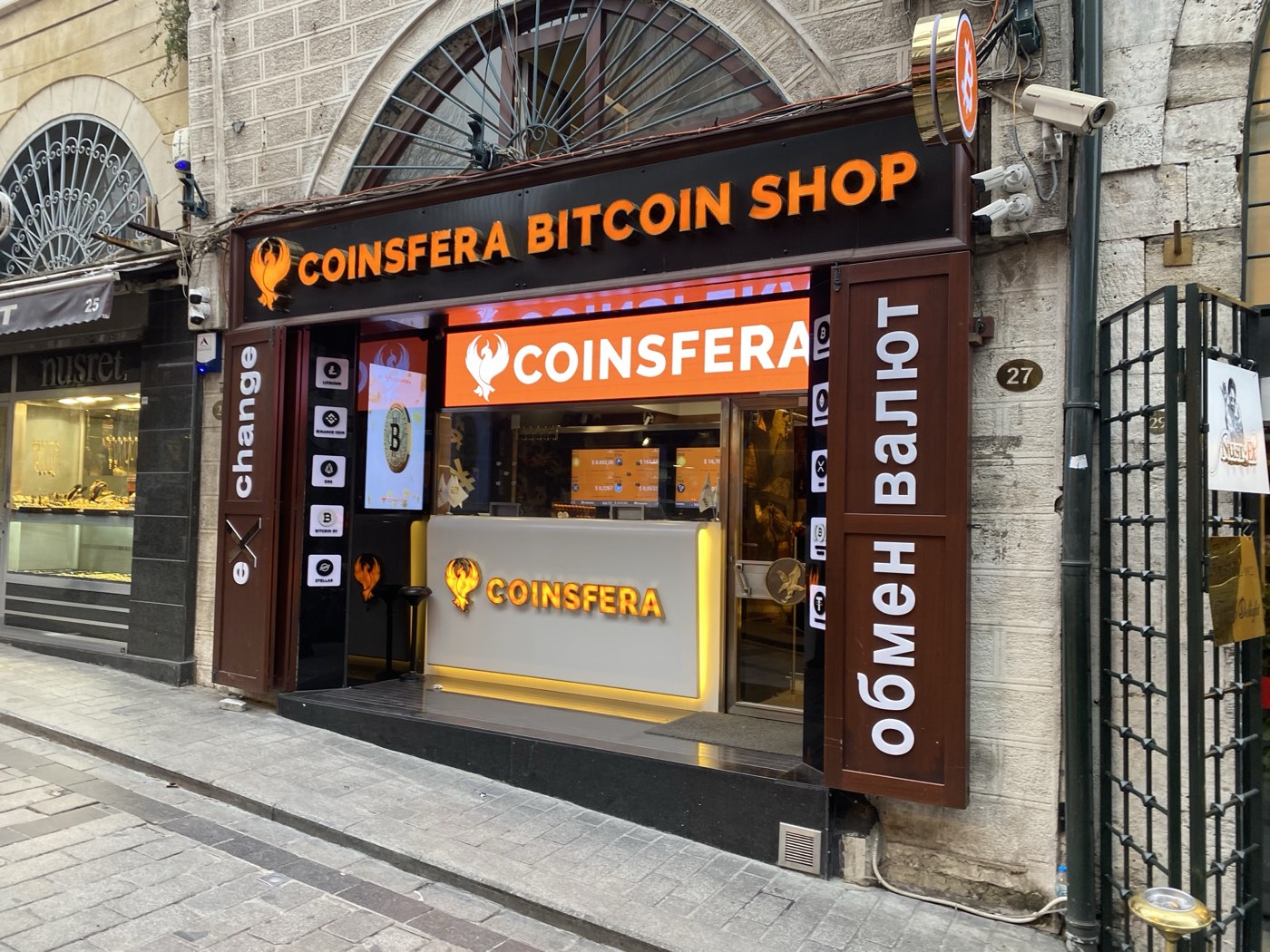
Type "coinsfera istanbul exchange" into a search engine and you get two kinds of results: the company's own marketing, and thin affiliate pages that recycle it. Neither tells you what actually happens when you walk into an office in Karaköy with a stack of banknotes and walk out with Bitcoin in your wallet. This guide does. We are an independent guide — not affiliated with Coinsfera — and I have been in crypto since 2017, long enough to treat every "zero fees" claim as a question rather than an answer.
The short version: Coinsfera is a physical OTC (over-the-counter) crypto office — the company calls it a "Bitcoinshop" — operating since 2015 with its headquarters in Istanbul. You do not open an account, you do not deposit money on a platform, and there is no app to log into. You get a quote, book an appointment, show your passport, hand over cash (or receive it), and the coins move to a wallet address you control. According to the official site, a typical transaction completes in 10–15 minutes.
That model solves real problems — and creates a few of its own. If you want to buy and sell crypto in Istanbul in 2026, here is everything worth knowing before you go, including the parts the brochure leaves out.
What Coinsfera Actually Is (and Is Not)
Coinsfera is not an exchange platform in the Binance sense. There is no order book, no matching engine, no user dashboard, no login page. If you have ever searched for a "Coinsfera login" and found nothing, that is why — we wrote a whole page on the Coinsfera login question and the phishing risk around it, because fake login pages targeting that search are a genuine threat.
What Coinsfera is: a dealer. You are trading against the desk itself, at a price it quotes you, the way you would change dollars at a money changer. The company says it has served 68,849+ customers across 87,908+ transactions, with 24,871+ customer feedbacks — those are the official site's own counters, so treat them as a company claim rather than an audited figure. It lists offices in Istanbul, Dubai, London, and Pristina, with the Istanbul location at Müeyyedzade Mah., Necatibey Cd. No:51/A, 34425 Beyoğlu — a short walk from the Karaköy ferry terminal.
Per the official site, the desk handles 500+ cryptoassets — in practice the ones people actually trade are Bitcoin (BTC), Ethereum (ETH), Tether (USDT), USDC, BNB, SOL, XRP, LTC, TRX, and BCH — against five cash currencies: USD, EUR, TRY, GBP, and AED.
Who the OTC office model is for
Be honest with yourself about which of these describes you:
- Tourists and visitors holding foreign cash who want crypto without wiring money through a Turkish bank they do not have.
- People without local banking — new arrivals, expats mid-relocation, anyone whose bank blocks crypto-related transfers.
- Sellers who need physical cash today, not a bank transfer that lands in three days and triggers a compliance review.
- Larger buyers who prefer a fixed quote over watching an order book slip while a big market order fills.
- People who simply distrust platforms after Mt. Gox, FTX, and every exchange freeze since. A face-to-face deal that settles to your own wallet has a certain appeal.
If none of that is you — if you have a working bank account, small regular amounts, and patience — an online exchange will almost certainly be cheaper. More on that below.
Custodial vs Non-Custodial: The Five-Minute Primer
This matters more at an OTC desk than anywhere else, because the coins go straight to a wallet you bring. Get the wallet part wrong and no one can help you.
A custodial service — Binance, Coinbase, any exchange with a login — works like a bank. They hold the private keys; you hold an IOU on their books. Convenient, recoverable if you forget a password, and entirely dependent on the company staying solvent and cooperative.
A non-custodial wallet — MetaMask, Trust Wallet, or a hardware device like a Ledger — is your personal safe. The keys are derived from a seed phrase of 12 or 24 words. Whoever holds those words holds the money. Lose them, and there is no support desk, no password reset, no "forgot my phrase" link. Ever. Write the phrase on paper, store it offline, and never photograph it or type it into a website.
At Coinsfera, when you buy, staff send coins to the address you show them. That address should be from a wallet you set up yourself, ideally before you travel, and ideally tested with a tiny transfer first. Turning up with no wallet and installing one on shop Wi-Fi under time pressure is how people make expensive mistakes.
How a Deal Works, Step by Step
- Get a quote
Use the calculator on the official site or message the desk on WhatsApp (+90 537 414 09 09, per the official site). The number you see is indicative — OTC prices are only firm at the moment of the deal.
- Book an appointment
Appointments run through WhatsApp or Telegram. Office hours per the official site: Monday–Friday 09:00–18:00, Saturday 09:00–15:00, closed Sunday.
- Visit with valid ID
Bring your passport or national ID. This is mandatory
KYC— no ID, no trade, regardless of amount. Bring the phone with your wallet on it, charged. - Confirm the rate and settle
Staff quote the final rate, you accept or walk away. Cash is counted, coins are sent to your address, and you wait for on-chain confirmation before leaving. The whole thing typically takes 10–15 minutes, according to coinsfera.com.
Warning: If you are buying USDT, know which network your wallet expects before anyone presses send.
TRC-20(Tron) andERC-20(Ethereum) addresses are not interchangeable. USDT sent on the wrong network to an exchange deposit address is very often unrecoverable. Say the network out loud, twice, and confirm the first and last characters of the address on your own screen.
Supported Assets and Cash Currencies
| Category | What the desk handles | Notes |
|---|---|---|
| Major coins | BTC, ETH, SOL, BNB, XRP, LTC, BCH, TRX | The liquid, everyday inventory |
| Stablecoins | USDT, USDC | Confirm the network (TRC-20 vs ERC-20) before sending |
| Long tail | 500+ assets claimed per the official site | For anything obscure, confirm availability on WhatsApp first |
| Cash currencies | USD, EUR, TRY, GBP, AED | Ask which currency gets the best rate for your deal size |
Security Audit: KYC, ID, and Limits
From an auditor's perspective, the encouraging parts are structural. There is no platform holding customer deposits, so there is nothing to hack or freeze in the FTX sense — settlement is atomic: cash for coins, done. The identity check cuts both ways: it is friction for you, but it also means the desk operates above board rather than as a back-alley trade.
- ID is non-negotiable. Passport or national ID for every transaction. Anyone promising you a no-KYC cash deal in 2026 is describing something illegal, a scam, or both.
- Limits are conversational. There is no published tier table. Larger amounts mean more compliance questions, possibly source-of-funds documentation. Discuss big deals on WhatsApp before you show up.
- Geographic exclusions. Per the official disclaimer, Coinsfera does not serve US persons or certain sanctioned jurisdictions. US passport holders should not plan around this service.
- The travel rule is real. Global FATF travel-rule standards mean transfers to and from identified wallets and exchanges carry reporting expectations. Cash OTC is not a loophole around your own country's tax obligations.
Honest Pros and Cons
| Pros | Cons |
|---|---|
| No bank account or platform account needed | You physically carry cash — a mugging-risk and a border-declaration issue |
| Deal settles in 10–15 minutes to your own wallet | The spread can cost more than online exchange fees, especially on small amounts |
| Fixed quote for large amounts, no order-book slippage | No published tariff — the rate is only firm at deal time |
| Human staff who can catch a wrong-network mistake | Mandatory KYC on every deal; no US persons served |
| Operating since 2015 — long by crypto standards | Office hours only; no 24/7 access like an online platform |
The biggest financial question — what the spread actually costs you and how to negotiate it — deserves its own deep dive. We cover it in the Coinsfera fees and OTC spread guide, including a comparison against exchanges, P2P, and Bitcoin ATMs.
Five Mistakes First-Time OTC Buyers Make
After years of watching people walk in and out of cash desks — in Istanbul, Dubai, and a dozen other cities — the failure modes are remarkably consistent. None of them are the desk's fault; all of them are preventable in advance.
- Arriving without a wallet. The person who installs Trust Wallet at the counter, on public Wi-Fi, while three people wait behind them, is the person who later cannot find their seed phrase. Set up at home, write the phrase on paper, test with a small transfer.
- Not knowing the spot price. If you cannot say what Bitcoin trades at right now, you cannot evaluate any quote. The desk is not obliged to educate you; the free price app on your phone is.
- Confusing networks. The USDT buyer who gives an
ERC-20exchange deposit address and asks for aTRC-20transfer — or vice versa. This is the only mistake on this list that can be permanently unrecoverable. - Treating the indicative quote as a contract. The WhatsApp number you got at breakfast is not the rate at 16:45 after the market moved 3%. OTC quotes are firm at deal time, not before. Budget for that reality instead of resenting it.
- Talking about the deal. Telling a taxi driver, a hotel clerk, or a new acquaintance that you are off to buy Bitcoin with cash is a security failure, not small talk. The transaction is nobody's business until it is finished and the coins are confirmed.
Buying Crypto in Istanbul in 2026: The Regulatory Picture
Türkiye stopped being a regulatory grey zone. Under Law 7518, the Capital Markets Board — the SPK (CMB in English) — runs a licensing regime for crypto asset service providers. Platforms have had to apply for authorization, meet capital and custody requirements, and enforce serious KYC. In parallel, the EU's MiCA framework governs European providers, and Dubai's VARA licenses the Gulf market — relevant if you are also weighing the Coinsfera Dubai option for AED cash deals.
What does this mean for a cash OTC customer? Practically: expect the ID check to be strict and documentation questions on larger amounts to get more detailed each year, not less. The era of anonymous cash crypto is over everywhere that operates in daylight. If a desk anywhere offers to skip the paperwork, that is not a perk — it is a flag that you are the counterparty risk.
One more 2026 note: crypto is legal to hold and trade in Türkiye, but using it as a means of payment for goods and services has been restricted since 2021. Buying BTC at an office is fine; paying for your hotel in BTC is a different matter.
Coinsfera vs Online Alternatives
| Factor | Coinsfera OTC office | Online exchange (e.g. Binance) | P2P marketplace |
|---|---|---|---|
| Bank account needed | No — cash | Yes, for fiat rails | Sometimes |
| Typical cost | Spread, quoted at deal time | Low maker/taker fees, plus deposit costs | Varies; counterparty sets premium |
| Speed to self-custody | 10–15 minutes | Hours to days (deposit, trade, withdraw) | Minutes to hours |
| Counterparty risk | Low at settlement; verify the office is real | Platform custody risk until withdrawal | Highest — stranger risk, escrow disputes |
| KYC | Passport at the desk | Full onboarding, video checks | Platform-dependent |
My rule of thumb after years of watching people choose badly: small and regular, go online; large or cash-based or bankless, OTC earns its spread. A 1% spread on a laptop-sized purchase is annoying; a frozen bank transfer during a market move can cost far more.
If you do decide to visit, read the practical walk-through first — what to bring, how the office visit feels, and how to handle the cash leg safely — in our Coinsfera Bitcoinshop visitor guide.
Bottom Line
Coinsfera occupies a genuinely useful niche: a decade-old, KYC-compliant cash desk in a city where banking access and crypto demand do not always line up. It is not the cheapest way to buy Bitcoin, and it was never designed to be. It is a fast, physical, human-mediated one. Go in with your own tested wallet, a firm grasp of the network your coins travel on, a willingness to compare the quoted rate against the live market price on your phone — and the discipline to walk away if the numbers do not suit you. Confirm hours, address, and any recent policy changes on the official site before you travel; details change, and this guide is independent, not omniscient.
Frequently Asked Questions
Is Coinsfera a crypto exchange like Binance?
No. Coinsfera is a physical OTC office — you trade face to face against the desk at a quoted rate. There is no account, no order book, and no login system.
Where is the Coinsfera Istanbul office?
Müeyyedzade Mah., Necatibey Cd. No:51/A, 34425 Beyoğlu/İstanbul, in the Karaköy district. Confirm the address on the official site before visiting, and book via WhatsApp.
Do I need ID to buy crypto at Coinsfera?
Yes — a valid passport or national ID is mandatory for every transaction. This is standard KYC under Türkiye’s SPK licensing environment, not an optional extra.
How long does a transaction take?
According to coinsfera.com, a typical deal completes in 10–15 minutes: rate confirmation, cash counting, and an on-chain transfer to your wallet before you leave.
What cash currencies does Coinsfera accept?
USD, EUR, TRY, GBP, and AED, per the official site. Ask on WhatsApp which currency gets the best rate for your deal size — it is worth checking, as we explain in our fees guide.
Can US citizens use Coinsfera?
No. Per the official disclaimer, Coinsfera does not serve US persons or certain sanctioned jurisdictions.
Is buying crypto legal in Türkiye in 2026?
Yes — holding and trading crypto is legal, and service providers are licensed under the SPK (CMB) regime introduced by Law 7518. Using crypto as a means of payment for goods and services remains restricted.